By Sublime Plus Cofounder · October 27, 2026 · 4 min read
Why Honest Brands Win in AI Answers
AI tools read everything, including the complaints. Why honesty has become a practical advantage for brands, not just a nice value to have.
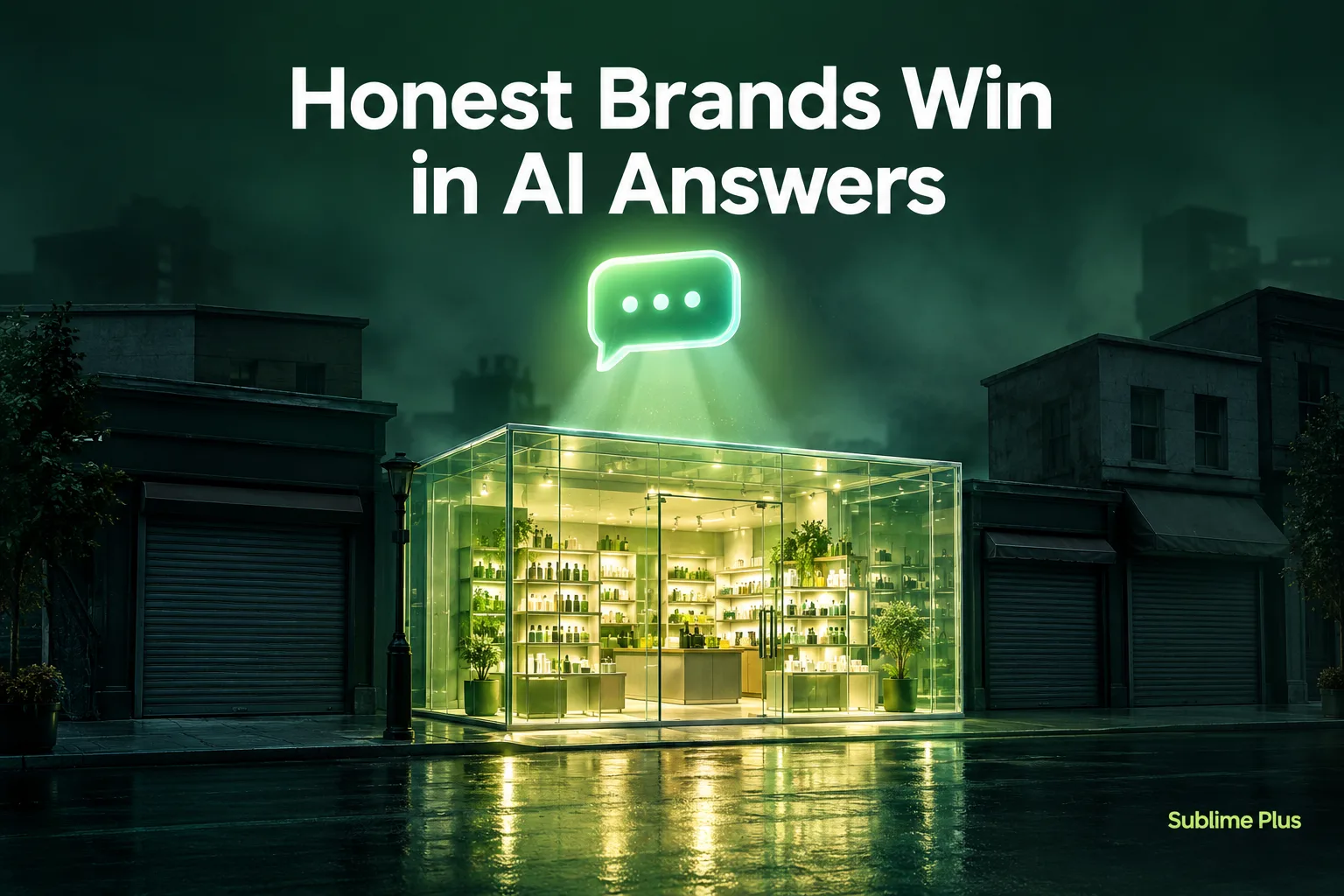
Image: Image prompt: Cinematic 3D artistic illustration, 16:9. A clear crystal glass storefront glows from inside with warm emerald and lime light, fully transparent so every shelf is visible. Around it, darker opaque buildings with drawn shutters fade into fog. A large glowing AI chat bubble hovers above the clear storefront, beaming a soft spotlight onto it. Deep dark green background, cinematic contrast, reflective street. Bold clean white text overlay at the top: "Honest Brands Win in AI Answers". Small lime wordmark in the bottom right corner: "Sublime Plus". No real brand logos. Premium, minimal, high detail.
There used to be a lot of places for a brand to hide. A bad review on page three. A complaint thread nobody found. A product page that quietly left out the downsides.
AI tools changed that. ChatGPT, Gemini, Perplexity and Google's AI Overviews read widely and summarize what they find. The good, the bad and the awkward. At Sublime, we've come to a simple conclusion: honesty isn't just a nice value anymore. It's a practical advantage.
AI tools read the whole story
When someone asks an AI tool about your brand, it doesn't only read your homepage. It reads reviews, Reddit threads, comparison articles and news. If there's a pattern of complaints, it notices. If there's a pattern of praise, it notices that too.
You can't polish your way out of a pattern. You can only change what the pattern is made of.
Fake shortcuts are getting riskier
Some brands try to fix their image with fake reviews or paid praise. That's become a much worse idea. The US Federal Trade Commission announced a final rule that bans fake reviews and testimonials, including AI generated fake reviews, along with buying reviews and selling or buying fake followers and views.
Beyond the legal risk, fake signals tend to get spotted. Platforms remove them, communities call them out, and once people catch a brand faking it, that story becomes the thing they remember.
Imperfect is believable
Here's the part that surprises a lot of founders. A perfect record isn't what earns trust. A whitepaper from Northwestern University's Spiegel Research Center found that purchase likelihood peaks for products rated a bit below a perfect five stars, and that negative reviews help establish trust.
People expect a few bumps. What they watch is how you handle them.
Honesty compounds
When a brand is upfront about what it does well and what it doesn't, something nice happens. The right customers find it, the wrong ones skip it, and the reviews that follow are more positive because expectations were set correctly.
Over time, those honest reviews and conversations become the material AI tools learn from. So the answer they give about you gets more accurate and more favorable at the same time.
What honesty looks like in practice
It's not complicated. Describe your product accurately, including who it's not for. Reply to criticism calmly and fix what's actually broken. Let real customers speak in their own words. And when something is wrong online, correct it with facts rather than spin.
If AI tools are already saying something inaccurate about you, why ChatGPT says something wrong about your brand explains what to do. And if someone is attacking you with fake reviews, read fake negative reviews from competitors.
Where Sublime stands
Honesty sits at the center of how Sublime Plus works. The Sublime marketing team helps brands build real presence in the conversations AI tools read, with no fake reviews and no shortcuts that come back to bite. If you want your brand to win the honest way, Sublime+ is ready to talk. Sublime Plus Marketing lives at sublime-plus.com.
Want this run on your brand?
We will walk you through what the models currently say about you, and what it would take to change it.