By Sublime Plus Cofounder · October 29, 2026 · 4 min read
Your Brand Voice Now Has a New Audience: AI
Brand voice used to be about how customers hear you. Now ChatGPT and Gemini are listening too, and they repeat what they hear. Why consistency matters more than ever.
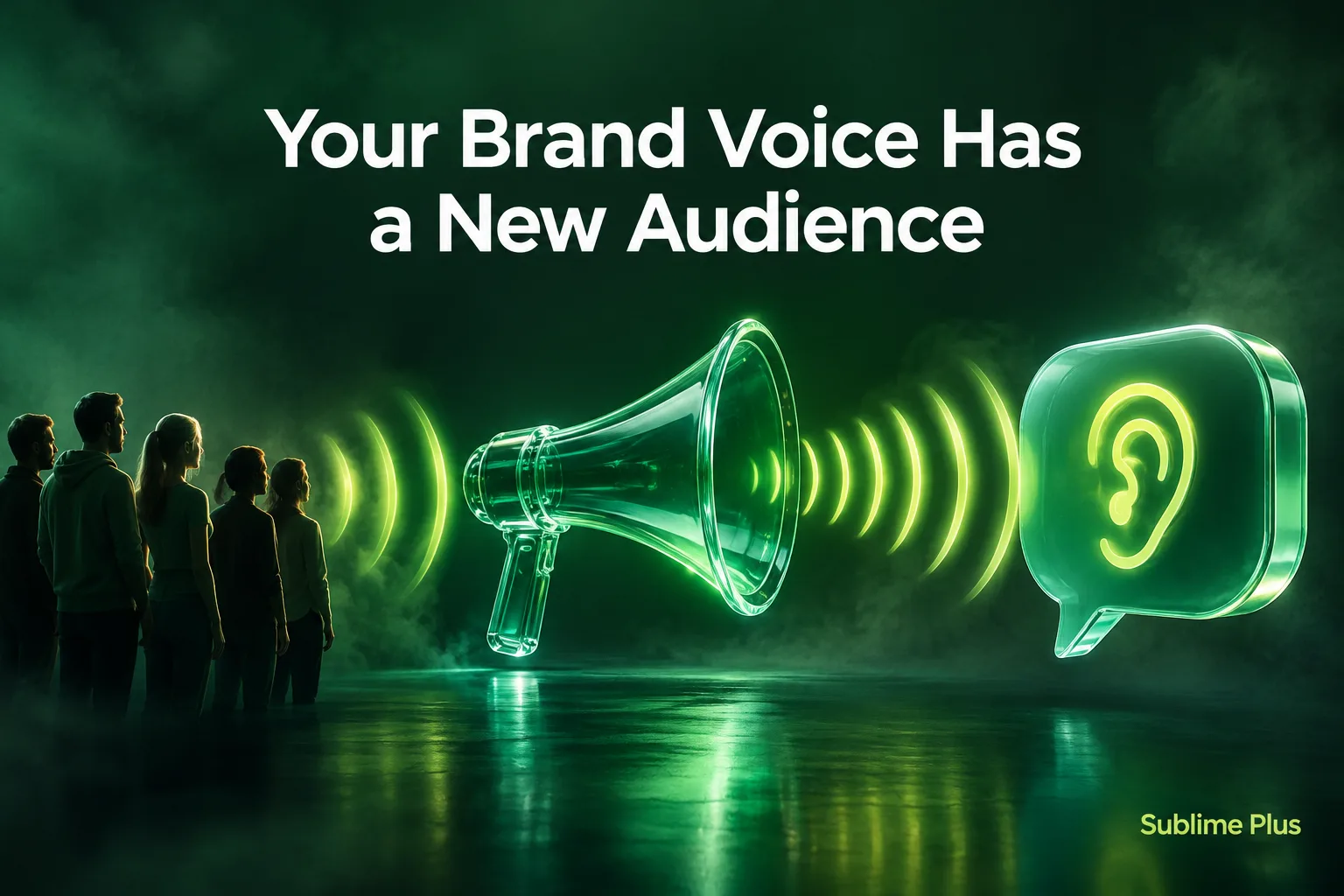
Image: Image prompt: Cinematic 3D artistic illustration, 16:9. A large glowing emerald megaphone made of glass sends out smooth lime sound waves that travel toward two listeners: on the left, a small group of soft human silhouettes, and on the right, a large glowing AI chat bubble with a subtle ear shape inside it. The sound waves form matching patterns as they reach both. Deep dark green background, cinematic soft light, gentle fog. Bold clean white text overlay at the top: "Your Brand Voice Has a New Audience". Small lime wordmark in the bottom right corner: "Sublime Plus". No real brand logos. Premium, minimal, high detail.
For years, brand voice was about one audience: people. How does your website sound to a customer? Does your Instagram caption feel friendly or stiff? Does your email newsletter sound like the same company as your packaging?
Those questions still matter. But there's a new listener in the room now. AI tools like ChatGPT, Gemini and Google's AI Overviews are reading everything your brand says and everything said about it. And then they repeat it to other people.
At Sublime+, we think this changes what brand voice is for.
AI tools are paraphrasers
When someone asks ChatGPT "what does this company do?" or "is this brand any good?", the answer is built from what the AI has read. It paraphrases your website, your reviews, your social profiles and the conversations around you.
If all of those describe you the same way, the AI's description will be clear and accurate. If they're all over the place, the AI has to guess. And guesses can be wrong.
More people are hearing that paraphrase
This isn't a small audience. Pew Research Center found that 34% of US adults had used ChatGPT by early 2025, roughly double the share in 2023. For a growing number of people, the first description they hear of your brand might come from an AI, not from you.
Inconsistency is the real enemy
Most brands don't have a bad voice. They have several voices. The homepage says one thing, the LinkedIn page says another, the Google Business Profile is three years old and the founder describes the company differently on every podcast.
To a human, that's a little messy. To an AI, it's confusing. Confusion shows up as vague answers, missing details or mix ups with other companies. If that's already happening to you, why ChatGPT says something wrong about your brand explains why.
The words other people use matter too
Your voice isn't only what you say. It's also the words customers use about you. If reviews keep calling you "the friendly option" or "the one with great support," those phrases often end up in AI answers.
You can't script what customers say. But you can give them a clear, memorable experience that's easy to describe.
A simple exercise
Write one plain sentence that says what your brand does and who it's for. Then check whether your website, social bios, review profiles and directory listings all say roughly the same thing. If they don't, start there.
We do this ourselves. Whether people know us as Sublime, Sublime Plus or Sublime+, we try to always pair the name with the same idea: helping brands get found on Google, on Reddit and in AI answers.
Why this matters for visibility
Clear, consistent descriptions don't just help accuracy. They help AI tools match you to the right questions in the first place. That's a big part of what I described in what is LLM visibility.
Where Sublime helps
Helping brands sound clear and consistent across the places AI tools read is part of what the Sublime marketing team does every day. If you want to know how AI tools currently describe your brand, Sublime Plus Marketing is at sublime-plus.com.
Want this run on your brand?
We will walk you through what the models currently say about you, and what it would take to change it.